
I’ve always been obsessed with ambiance and the feeling of place… the music, the lighting, the crowd energy, the sense of possibility when you enter a space. Traditional search tools don’t capture that. They tell you what a place is (coffee shop, bar, wine lounge), but not how it feels.
As I started learning prompt engineering and exploring AI-assisted creativity, I realized I could actually codify vibe: translate mood, texture, and sensory cues into structured data and usable recommendations.
Vibecoding is a vibe…
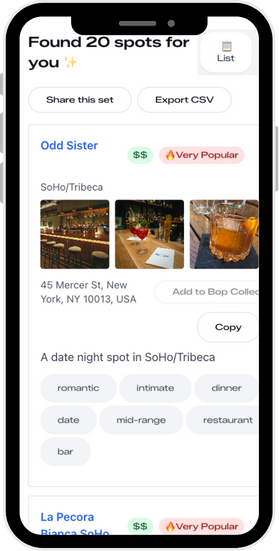
Bop is a vibe-first discovery app I built entirely in Replit. Instead of filtering by “café” or “cocktail bar,” you tell Bop the vibe you’re going for (e.g. wifi café, dog-friendly patio, new-era lounge, cozy date, solo outing, girls’ night, artsy cocktail, etc.) and the app returns a curated shortlist that actually fits the moment. You can also collect “Bop Lists”, share them with your friends, and follow others.
Case Study: “Bop”
Why I made it!
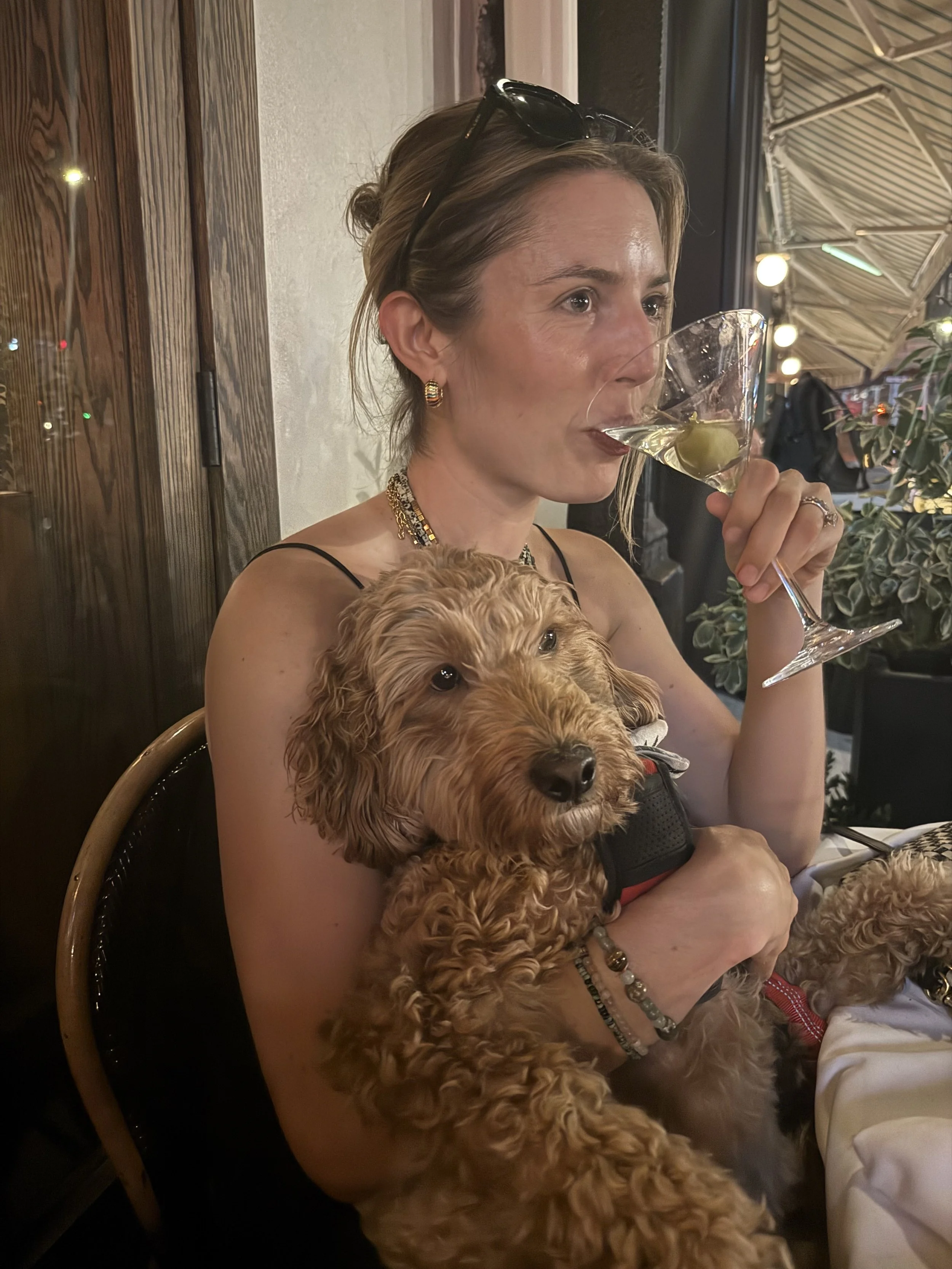
The idea started because I needed something incredibly specific: a wifi-friendly café in NYC that also allows dogs.
A simple request that none of the existing platforms could answer.
I kept running into the same problems:
Too many irrelevant results
No sense of atmosphere
No verification of mood, music, or crowd energy
One-size-fits-none categories
I wanted to easily find:
a chill place to work with my dog,
a fun but not chaotic spot for friends,
a cozy date bar with the right lighting,
a lounge that plays trip-hop instead of top 40.
The Process
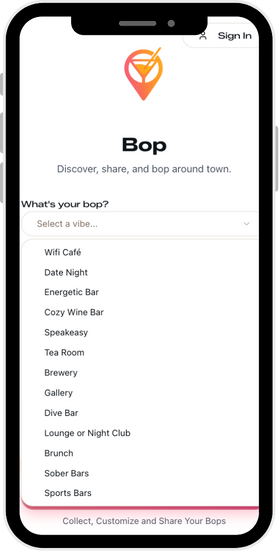
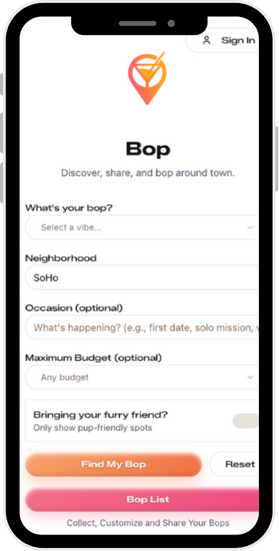
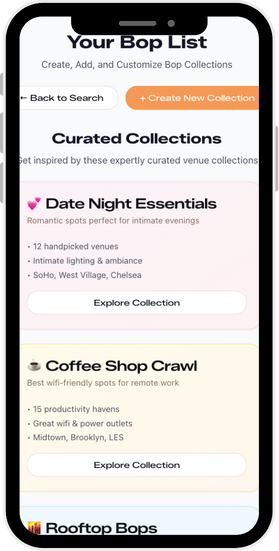
I built Bop through fast, iterative prototyping in Replit, combining with no coding, API integrations, and prompt engineering to classify venues by vibe. The goal was speed, clarity, and the ability to test ideas in the real world immediately.
Here’s the breakdown of the build:
1. Prototyping in Replit
I used Replit as the development environment to:
structure the app logic,
build the initial UI flow,
manage data models for vibes and venue attributes,
and rapidly deploy changes for live testing.
2. Google Places + Maps API Integration
To power Bop’s underlying venue data, I integrated:
Google Places API: for place details, hours, metadata, pricing, amenities.
Google Maps API: for location search, distance calculations, lat/long parsing, and neighborhood clustering.
3. Vibe Classification Engine
Using prompt engineering, I built a classification layer that:
interprets Google reviews to extract tonal cues (lighting, music, crowd type),
maps qualitative phrases (“pretty chill,” “gets loud at night,” “great for dates”) into structured vibe tags,
generates lightweight descriptions using consistent language.
4. Vibe Taxonomy Development
I designed a vibe vocabulary based on real-life use cases:
wifi café
dog-friendly patio
new-era lounge
cozy date
artsy cocktail
solo outing
group hang
mellow martini hour
(and many more being added)
5. Real-World Testing with Friends
Every iteration was field-tested:
used it on walks with Sochi to validate dog-friendly + seating logic
tried it on date nights to test intimacy + lighting tags
asked friends to test for girls’ nights, solo sessions, and “somewhere fun but not chaotic”
validated music vibes while out DJing or visiting lounges
6. Iteration & Refinement
Because it lived in Replit, updates were instant. I could:
refine prompt-engineered outputs,
tweak the UI,
fix mismatches quickly,
and continuously improve based on actual nights out.